


Resources / Digital Manufacturing Transformation: From Smart Factories to Intelligent Enterprises
Digital Manufacturing Transformation: From Smart Factories to Intelligent Enterprises
Why digital manufacturing transformation is a business strategy, not a technology project: the five pillars, the role of Industry 4.0 and why programmes fail.
Executive Summary
Manufacturing organisations are facing unprecedented pressure. Global competition, rising operational costs, supply chain disruption, labour shortages, sustainability targets, and increasing customer expectations are forcing manufacturers to rethink how they operate. Traditional approaches to production optimisation are no longer sufficient to deliver the agility, resilience, and efficiency required in today's marketplace.
Digital Manufacturing Transformation has emerged as a strategic imperative rather than a technology initiative. Organisations that successfully harness digital technologies are creating connected, intelligent operations capable of responding dynamically to changing market conditions while driving measurable improvements in productivity, quality, and profitability.
However, digital transformation is not simply about implementing new technology. It is about fundamentally reimagining how products are designed, manufactured, delivered, and supported. The most successful manufacturers are those that align technology investments with business outcomes, creating an integrated digital ecosystem that spans the entire value chain.
This paper explores the drivers, challenges, opportunities, and practical considerations shaping the future of Digital Manufacturing Transformation.
The Manufacturing Imperative
Manufacturing has entered a period of continual disruption.
Over the last decade, organisations have faced:
- Global supply chain volatility
- Increasing material and energy costs
- Labour and skills shortages
- Tightening regulatory requirements
- Growing sustainability expectations
- Demand for faster product innovation
- Rising customer expectations around quality and delivery
At the same time, advances in cloud computing, artificial intelligence, industrial IoT, robotics, and advanced analytics have created new opportunities to modernise manufacturing operations.
The challenge for many organisations is that operational models, systems, and processes often remain rooted in legacy approaches designed for a very different business environment.
The result is an increasingly common disconnect between strategic ambition and operational capability.
What Is Digital Manufacturing Transformation?
Digital Manufacturing Transformation is the integration of digital technologies, data, people, and processes to improve operational performance and create new business value.
It extends far beyond factory automation.
True transformation encompasses:
Connected Operations
The integration of enterprise systems, production environments, supply chains, and customers through a unified digital ecosystem.
Data-Driven Decision Making
Leveraging real-time operational data to optimise processes, improve forecasting, and support strategic decision making.
Intelligent Automation
Using robotics, machine learning, and process automation to reduce manual intervention and improve consistency.
Continuous Optimisation
Creating the capability to identify inefficiencies and implement improvements at speed.
Sustainable Manufacturing
Reducing waste, emissions, and resource consumption through improved visibility and optimisation.
The objective is not merely digitalisation. It is the creation of a more intelligent and adaptive manufacturing enterprise.
The Five Pillars of Digital Manufacturing Transformation
While every transformation journey is unique, successful programmes are typically built around five core pillars.
1. Connected Data and Systems
Many manufacturers still operate with fragmented technology landscapes.
Common challenges include:
- Isolated production systems
- Manual reporting processes
- Spreadsheet-driven planning
- Limited visibility across facilities
- Inconsistent operational data
Without connected information flows, decision-making becomes reactive and inefficient.
Digital leaders establish integrated environments connecting:
- ERP platforms
- Manufacturing Execution Systems (MES)
- Warehouse Management Systems (WMS)
- Quality systems
- Asset management platforms
- Supplier systems
- Customer systems
This creates a single source of truth across the organisation.
2. Smart Factory Operations
The smart factory has become the cornerstone of modern manufacturing.
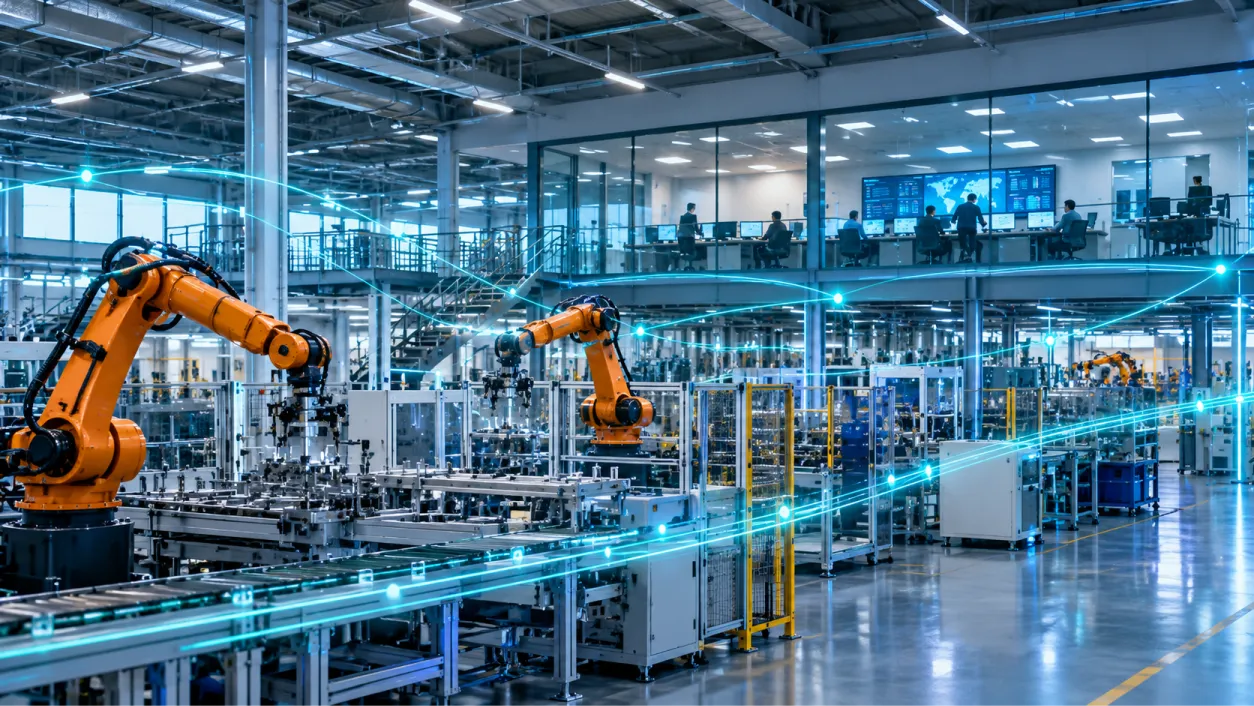
Through the deployment of sensors, connected equipment, and industrial IoT technologies, organisations can gain real-time visibility into production activities.
Benefits include:
- Improved Overall Equipment Effectiveness (OEE)
- Reduced downtime
- Enhanced quality control
- Better capacity utilisation
- Faster issue resolution
Rather than reacting to problems after they occur, manufacturers gain the ability to predict and prevent operational issues before they impact production.
3. Advanced Analytics and Artificial Intelligence
Manufacturers generate vast amounts of operational data, yet much of it remains underutilised.
Advanced analytics and AI provide opportunities to unlock significant value through:
Predictive Maintenance
Identifying equipment failures before they occur.
Demand Forecasting
Improving planning accuracy and reducing inventory risk.
Quality Prediction
Detecting potential product defects earlier in production cycles.
Production Optimisation
Improving throughput while reducing waste and energy consumption.
Organisations that effectively leverage data increasingly outperform competitors in both operational efficiency and profitability.
4. Workforce Enablement
Despite increasing automation, people remain central to manufacturing success.
Many transformation programmes fail because they focus heavily on technology while overlooking workforce adoption.
Modern digital workplaces enable employees through:
- Mobile technologies
- Digital work instructions
- Augmented reality support
- Real-time production dashboards
- Collaborative planning tools
- Skills development programmes
Transformation succeeds when technology enhances human capability rather than replacing it.
5. Sustainable and Resilient Operations
Environmental performance is becoming a strategic business priority.
Customers, investors, and regulators increasingly expect manufacturers to demonstrate measurable progress against sustainability objectives.
Digital technologies enable organisations to:
- Monitor energy usage
- Optimise resource consumption
- Reduce manufacturing waste
- Improve carbon reporting
- Support circular economy initiatives
At the same time, greater visibility across the supply chain improves resilience and risk management.
The Role of Industry 4.0
Industry 4.0 has become synonymous with digital manufacturing.
It represents the convergence of operational technology and information technology through:
- Industrial Internet of Things (IIoT)
- Cloud computing
- Artificial Intelligence
- Advanced Robotics
- Digital Twins
- Edge Computing
- Autonomous Systems
While these technologies provide important capabilities, successful transformation programmes do not begin with technology selection.
They begin with business objectives.
The question should never be:
“How do we implement AI?”
Instead, it should be:
“How do we reduce downtime, improve quality, increase capacity, or increase profitability?”
Technology should be an enabler of business outcomes rather than an objective in itself.
Why Many Transformation Programmes Fail
Despite significant investment, many manufacturing transformation initiatives fail to achieve expected value.
Common causes include:
Technology-Led Rather Than Business-Led Strategies
Technology implementations without clear business outcomes often struggle to achieve adoption or measurable value.
Poor Data Quality
Advanced analytics cannot compensate for incomplete, inconsistent, or inaccurate data.
Insufficient Change Management
Employees must understand, support, and adopt new ways of working.
Siloed Programmes
Transformation initiatives frequently focus on isolated departments rather than creating enterprise-wide value.
Lack of Executive Sponsorship
Successful transformation requires leadership commitment across operations, technology, finance, and manufacturing functions.
Without strong governance, initiatives can quickly lose momentum.
Measuring Transformation Success
Successful manufacturers focus on measurable business outcomes rather than technology deployment metrics.
Common performance indicators include:
| Operational Area | Example Metrics |
|---|---|
| Productivity | OEE, throughput, cycle time |
| Quality | First-pass yield, defect rates |
| Maintenance | Downtime reduction, asset availability |
| Supply Chain | Inventory turns, forecast accuracy |
| Sustainability | Energy consumption, waste reduction |
| Financial | Cost per unit, margin improvement |
| Customer Experience | On-time delivery, order fulfilment accuracy |
The most effective programmes establish baseline measurements before transformation begins and continually track progress against defined objectives.
The Future of Manufacturing
The next generation of manufacturing will be characterised by intelligent, autonomous, and highly connected operations.
Emerging trends include:
AI-Powered Decision Making
Real-time optimisation of production schedules, inventory levels, and maintenance activities.
Digital Twins
Virtual representations of facilities, production lines, and products that allow organisations to simulate scenarios before implementing changes.
Hyperautomation
The combination of robotic process automation, AI, analytics, and workflow orchestration to automate increasingly complex business processes.
Autonomous Production
Self-adjusting production environments capable of responding dynamically to changing conditions.
Sustainable Manufacturing Ecosystems
Greater visibility into environmental impact throughout the product lifecycle.
The manufacturers that embrace these capabilities effectively will create significant competitive advantage over the coming decade.
Conclusion: Transformation Is a Business Strategy, Not a Technology Project
Digital Manufacturing Transformation is often discussed in terms of smart factories, automation, artificial intelligence, and Industry 4.0 technologies.
However, the organisations achieving the greatest results understand a more fundamental truth.
Transformation is not about deploying technology.
It is about creating a manufacturing business that is more agile, resilient, efficient, and customer-focused.
Technology provides the tools, but success depends upon leadership, culture, data, processes, and a clear understanding of the outcomes the organisation is trying to achieve.
As economic pressures continue to grow and competitive landscapes become increasingly challenging, digital transformation is no longer optional. It is becoming a defining characteristic of the manufacturers that will lead their industries in the years ahead.
The future belongs to manufacturers that can turn data into insight, insight into action, and action into measurable business value.